I work hard so my dog can have a decent life
Just a few decades ago, dogs slept in kennels, were "chained," and served as guards. Today? They sleep in beds, eat better than many humans, and have their own car seat. What's changed? Everything. Because we've changed. And with us, the dog's place in our world has changed.
This isn't a piece about luxury. It's about changing values, about a quiet social revolution unfolding before our eyes. A generation ago, a dog was just an accessory—to the yard, to childhood, to chores. Today, it's increasingly becoming the center of our daily lives. Our planner, our household budget, our vacations, even our housing decisions—we plan everything with our dog in mind.
Some look on in disbelief: "That's an exaggeration." But more and more of us answer: "No, it's love. It's responsibility. It's a relationship." In an increasingly atomized, lonely, and fast-paced world, a dog provides a haven, stability, and meaning. He doesn't count professional successes, doesn't judge appearances, and doesn't know anything about careers. But he knows when we're sad. And he's always there.
In this article, we won't just wallow in sweetness over their sweet faces. We'll take a deep, analytical look at how the dog's place in society has changed, what this says about us, and why we work hard to ensure our dogs live decent lives—sometimes even better than we do ourselves.

Dogs then and now – a social revolution
Social change sometimes happens slowly, almost imperceptibly. But when we look at the relationship between humans and pets—especially dogs—we see a true cultural revolution.
Back in the 1990s, the dog was mainly:
- a work tool (shepherd dog, guard dog),
- security guard of the property ,
- a toy for children (“so they have company” or “learn responsibility”),
- a racial ornament , sometimes treated more like a trophy than a living being.
He was "outside", "on a chain", "on a leash" - rarely in the heart.
In those days, a strong division still prevailed: humans were the superior beings, and dogs were the obedient executor of commands . Training was based on dominance, obedience, and punishment. When a dog "was naughty," it often resulted in aggression—physical or psychological. Veterinary care was limited to vaccinations and deworming. No one spoke of a dog's mental health.
Today, everything is changing. The dog is no longer "outside"—he's inside . In the home, in life, in the heart.
The modern caregiver understands that a dog:
- has its own emotions,
- has the right to boundaries,
- needs mental stimulation,
- he is not "malicious", he is just reacting to stress or frustration,
- requires just as much attention as a human being – especially in terms of mental health and relationships.
Language is also changing. We no longer say, "My dog MUST listen to me." We say, "I want him to understand me," "I want to be supportive."
With advances in veterinary, behavioral, and social knowledge, the dog is gaining agency. It is no longer a means to an end. It is an end in itself.
New professions and social roles related to dogs have emerged:
- behaviorists,
- dog physiotherapists,
- groomers with zootechnical education,
- dog home caretakers,
- animal dietitians,
- brands producing premium equipment for dogs (like PETTO).
All this shows how far the dog's place has shifted – from the margin of family priorities to the center of them .
Today, a dog is not an "accessory." It is an important point of reference in lifestyle, values, and daily decisions .
Once there were children, now there are dogs – demographics don't lie
Shifting social priorities and dynamic demographic changes clearly demonstrate that the role of dogs in human life is constantly growing—and this is not a passing trend, but a lasting cultural phenomenon. In Poland, as across Europe, more and more couples are choosing to live without children or postpone parenthood. Instead, someone else appears… a dog.
According to data from the Central Statistical Office and Eurostat:
- More and more people live alone,
- The number of childless couples is growing,
- The average age of women giving birth to their first child is increasing,
- The fertility rate is falling,
- More and more people declare their attachment to pets as part of the family.
In this context, a dog often becomes a child substitute —not in a superficial or surrogate sense, but in an emotional and social sense. They're someone we cook for, plan vacations for, and shop for. They have their own clothes, health insurance, a social media profile, and sometimes even their own walker.
Social media is dominated by hashtags like:
- #dogmom
- #dogdad
- #furbaby
- #doglikechild
This isn't just a play on language. It's an expression of deep identification and a redefinition of the concept of family .
For many young people, a dog is the first "someone" they truly care about. Someone with whom they learn responsibility, building relationships, budgeting, and healthcare. A dog is their first emotional "child"—and sometimes their only one.
It's no coincidence that the premium dog products market is growing – sales of orthopedic beds, specialized dog food, car carriers, and natural sensory toys are growing rapidly year over year. Companies like PETTO are aptly responding to these needs, offering products that are not only useful but also stylish, aesthetically pleasing, and designed with a dog's physical and emotional needs in mind.
This isn't a passing fad. It's a lasting, intergenerational change. And as long as our dog is family, we'll work hard—not for ourselves, but for him.
An emotional bond stronger than ever
Never before in history have humans been so emotionally connected to their dogs as they are today. A relationship that was once based on function—guarding, hunting, watching—has now taken on a completely new dimension. It's no longer merely a utilitarian relationship. It's a deep, mutual emotional dependence that shapes the daily lives of millions of people around the world.
The modern dog is often:
- companion of loneliness ,
- mood regulator ,
- therapeutic assistance in mental illnesses ,
- motivation to act, to get up, to move, to live.
For many caregivers, a dog is the first and often only "person" they share their day with. Someone who doesn't judge, interrupt, or disappoint. They simply are . And this presence—nonverbal, yet deeply felt—has a powerful impact on a person's mental and emotional health.
Research by psychologists and ethologists shows that dogs:
- lowers the level of cortisol (stress hormone),
- increases the production of oxytocin (bonding hormone),
- improves sleep quality and circadian rhythm,
- can alleviate symptoms of depression, anxiety, and loneliness,
- promotes social contacts (conversations during walks, building neighborly bonds).
It's not without reason that dogs are used in dog therapy, working with children on the autism spectrum, with the elderly, and with veterans suffering from PTSD. A dog doesn't speak, but its presence says it all.
Interestingly, this bond works both ways. Dogs who live in homes filled with empathy and care are:
- calmer,
- more resistant to stress,
- are more willing to learn,
- live longer and in better health.
This isn't one-sided care. It's a relationship. And every relationship based on respect, understanding, and love is life-changing. For both the person and the dog.
That's why we work hard – to give our dogs a decent life. Because we know they give us the same every day. Sometimes, even more.
A decent life for a dog – a new standard for the 21st century
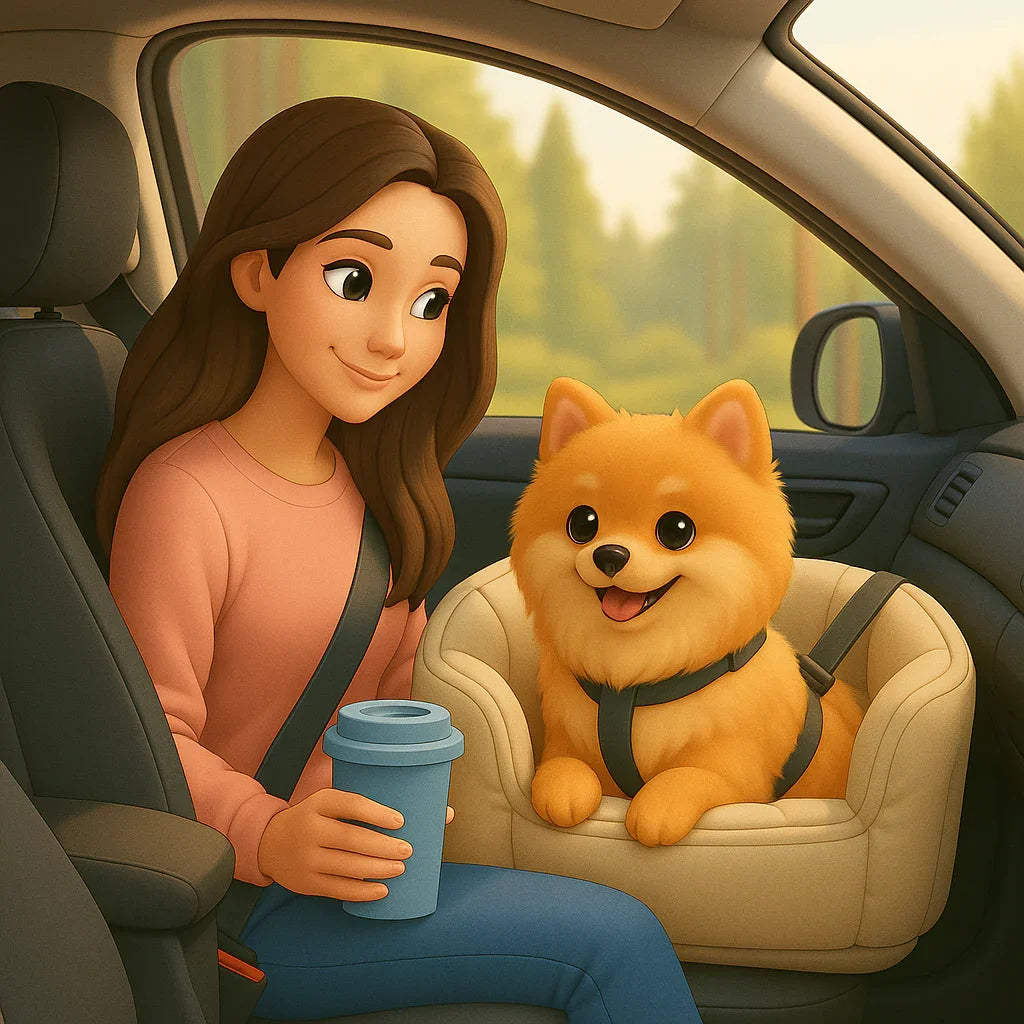
In the past, dogs were fed leftovers, slept in the garage, and were only taken to the vet when seriously ill. Today? They have their own food—adapted to their breed, age, allergies, and taste preferences. They sleep on a dedicated memory foam bed. And they travel in an approved car seat, often better protected than a passenger.
This change isn't the result of coddling. It's the result of growing awareness.
Awareness that the dog:
- has physical and emotional needs ,
- feels stress, pain, anxiety ,
- needs mental stimulation and socialization ,
- is not immune to noise, crowds, stimuli like humans.
That's why more and more caregivers:
- chooses human grade food ,
- uses the services of dog behaviorists,
- buys orthopedic beds , like PETTO Osaka Fluffy ,
- ensures safe transport – e.g. in the PETTO Oi seat ,
- planning a holiday with a dog and for the dog,
- goes for walks not only "out of necessity", but also to build relationships.
A dog no longer "has to be well-behaved"—it can have its own emotions . It can be afraid, it can be frustrated, it can need space. This mental shift—from training to communication—is a true breakthrough, transforming not only the lives of dogs but also our own.
A decent dog life is no longer an extravagance. It's a new social standard . Expected, natural, necessary.
And if I work hard for my dog to have all this, it's because every day he gives me something that no amount of money can buy: presence, loyalty, a sense of purpose.


When others buy, I invest in the well-being of my dog
This isn't a story about sacrifice. It's a story about choices. While others invest in new phones, designer clothes, or gadgets, more and more owners are investing in their dogs' quality of life . And this isn't about the proverbial "coddling." It's about consciously deciding what truly matters .
Instead of an all-inclusive vacation, consider a weekend in the mountains with your pet. Instead of a designer sofa, consider a comfortable OEKO-TEX®-certified dog bed. Instead of a spontaneous purchase, consider a well-planned visit to a canine physiotherapist.
These aren't sacrifices. They're priorities. Because when you see your dog fall asleep feeling safe after a walk, when you see the relief from a change in diet, or the joy of a new sniffing toy – you know it was the best investment of the day .
Products dedicated to dogs are now at an unprecedented level of quality:
- cooling mats,
- carriers and air carriers,
- car seats with seat belts,
- sensory and logical toys,
- functional clothing for winter and rain,
- natural supplements and veterinary food.
For a conscious owner, a dog isn't a cost. A dog is a value. Therefore, purchasing decisions are carefully considered, consulted, and responsible.
And even though it sometimes means working overtime, putting in extra hours on the weekend, or putting your own plans on hold – it's worth it . Because nothing brings as much satisfaction as seeing a dog who has everything he needs to be happy.
Ultimately: I work hard so that my dog can have a decent life – but thanks to him, this life also has meaning.


A dog changes everything – including me
Not only has the dog benefited from the new social model, but I have benefited as well – as a human being. The daily presence of a dog teaches me things that no school, no course, no interpersonal relationship could ever teach me.
Thanks to him:
- I am more patient,
- I can stop and breathe,
- I take care of my daily rhythm and health,
- I move more often,
- I rediscover the joy of small things,
- I learned to communicate without words – more carefully, more quietly, with respect.
My dog has become my mirror. He shows me when I'm tense, irritated, or absent. He forces me to be present here and now. He compels me… or rather, invites me ? Because it's not a compulsion, but a tender motivation.
In a world overstimulated, noisy, and full of expectations, a dog shows me that being myself is enough . That I don't have to earn love. That I don't have to prove anything. He simply is. And I, too, can simply be.
That's why I work hard to give my dog a decent life. Because—without a word—he makes my life better every day. And maybe even… more human.
I am not an exception – there are more and more of us
This isn't an isolated experience. My story is part of a larger, growing social movement. Just look at social media, city parks, pet stores, social campaigns, and city investments. A dog is no longer just "someone's dog." It's a social phenomenon.
With each passing year:
- the number of dog-friendly cafes and hotels is increasing,
- developers are designing housing estates with dog runs,
- applications are being created that connect dog owners for walks,
- cities are implementing programs for free neutering, chipping, and care for homeless dogs,
- and marketing increasingly includes dogs as full-fledged "customers" of campaigns.
This is a new quality of social life – more empathetic, responsible, attentive.
Science is also increasingly focusing on the human-dog relationship. Research on the canine brain, emotionality, memory, and cognitive abilities shows one thing: dogs are sentient, intelligent, and relational beings. And we have finally begun to treat them as such.
So I'm no exception. There are many of us. Millions of people around the world who work hard to give their dogs a good, safe, and loving life. And perhaps it's dogs who have made us—humans—also begin to live better, wiser, and with greater heart.
Summary – the dog as a symbol of a new society
How we treat our canine companions says more about us than any survey or ideological statement. Sensitivity, responsibility, empathy, and everyday, quiet decisions—these are what demonstrate that something has changed within us. A dog has become not just a family member, but a symbol of a new quality of life—based on relationship, not utility.
I work hard so my dog can have a decent life. But really… he shows me every day what a life worth living looks like. Thanks to him, I'm more present. More human. And happier.
Because maybe it wasn't me who saved him.
📚 Additional materials
- How to Tell If Your Dog Is Bored: 10 Signs You Can't Ignore
-
TOP 10 Most Intelligent Dog Breeds – Which Ones Will Surprise You With Their Cleverness?
- 🏙️ Best dogs for apartments – breed ranking
- 💬 How Do Dogs Show Affection? Signals You Should Know
- 🐕 Is your dog pulling on the leash? Find out how to fix it.
- 🚗 How to safely transport a dog in a car?
- 🐾 How to teach your dog to stay home alone
- 🛏️ Can a dog sleep in bed with its owner? Facts, myths, and behavioral advice.
See more at: Petto.com.pl
 https://petto.com.pl/
