
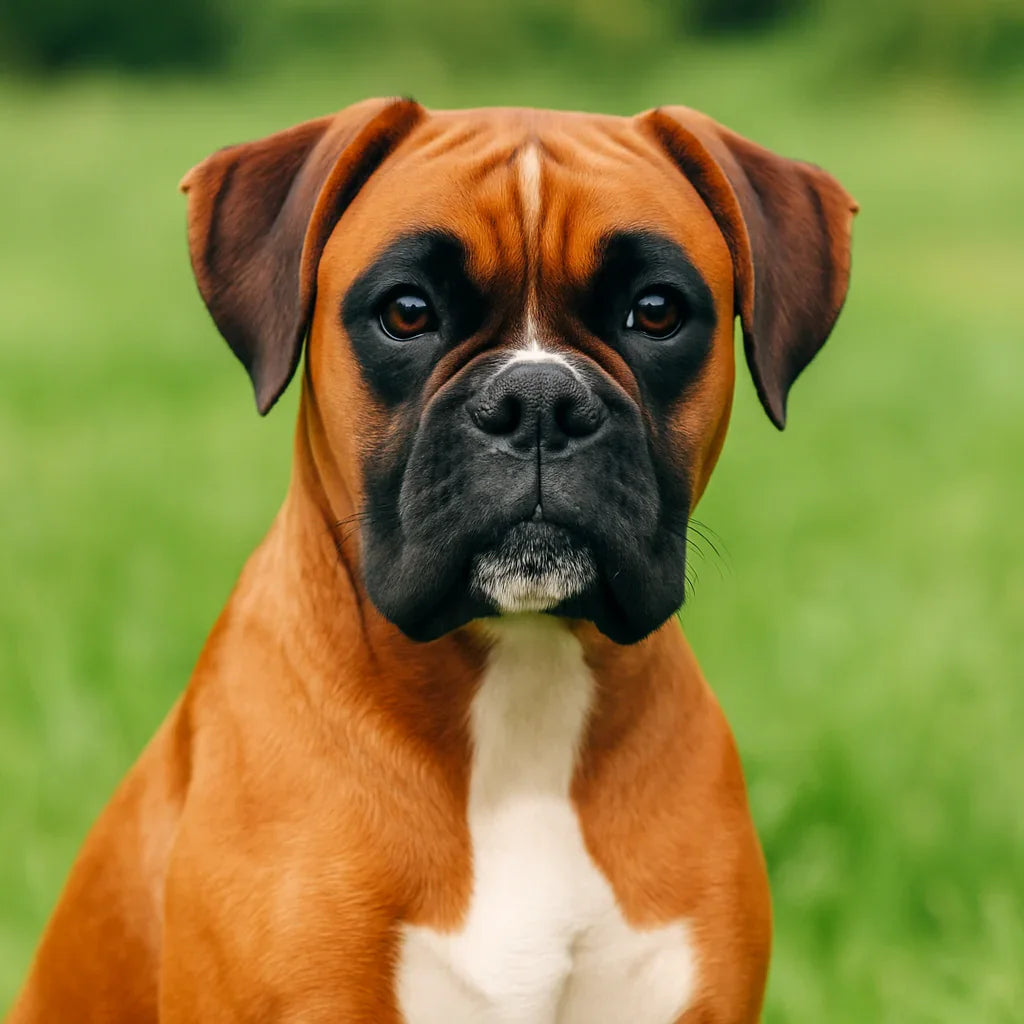
Boxer – a volcano of energy, a faithful friend and guardian of the family
The Boxer is a dog breed that's impossible to ignore. This medium-sized, muscular dog combines boundless energy with immense charm. He's known for his perpetually wagging tail, wide "smile," and mischievous twinkle in his eye. Although sometimes mistaken for a menacing appearance, the Boxer is actually a cheerful, affectionate, and devoted family companion. In this article, we'll introduce you to this extraordinary breed—from the Boxer's colorful history , through a description of its appearance and personality , to practical tips on nutrition, health, and training . You'll learn how the Boxer behaves around children , what requirements it has as a dog for an active family, and what a beginner owner should prepare for. We'll also include interesting facts and expert opinions. If you dream of a dog that's both energetic and a loyal friend , a Boxer might just steal your heart!
Why is a boxer a unique family dog?
Boxers are winning the hearts of dog lovers worldwide. It's no wonder – they combine extraordinary liveliness with devotion and loyalty . These dogs can entertain household members with their antics, while also standing up for them when needed. The Boxer is often called the "eternal puppy" because even into adulthood, they retain their youthful zest for life. Imagine a morning with a Boxer: you wake up to find your dog waiting by your bed with a favorite ball in his mouth and a look that says, "Let's play!" Moments later, he's running alongside you on your morning jog, only to snuggle up next to you on the couch in the evening, snoring loudly after a day full of excitement.
The Boxer thrives in a family environment. He loves being the center of attention and actively participating in the lives of his family. This dog is equally enthusiastic about running for a long walk and playing on the carpet with children. His lively nature is matched by a gentle heart – a well-behaved Boxer is patient with little ones and understanding, even when a child accidentally tugs on his ear. Many owners joke that the Boxer is a "big kid" in a dog's clothing, loving cuddles and the warmth of family.
What makes a Boxer so special as a family dog ? Above all, their unwavering loyalty . This dog develops a strong bond with "its" people and always tries to keep an eye on them. When family members are nearby, Boxers are happiest – they need human contact almost as much as exercise and play. If you're looking for a dog that will be both a companion for activity and a loving cuddle at your feet, the Boxer will meet your expectations.
"The Australian thinks boxers are walking memes , or at least he can't take them seriously. He compares them to schoolyard clowns . He likes them from afar and likes having them, but he couldn't live with them. They're very athletic and easy to train, but they're like those guys who are always making jokes and everyone thinks they're idiots, but everyone loves them anyway, " one dog trainer admitted with a wink. This humorous description perfectly captures the boxer's temperament: a crazy comedian with a heart of gold . Despite his goofy nature, a boxer can instantly turn serious when threatened and defend his family. This unique blend of traits—playfulness, athleticism, intelligence, and courage—makes the boxer a one-of-a-kind dog.
It's no wonder Boxers have been among the most popular family breeds for years. In the United States alone, they're among the ten most popular breeds. They've also gained recognition as working dogs – formerly serving in the police and military, and even as guide dogs for the blind. However, it's as a loving home companion that the Boxer excels. So if you're looking for a dog that will brighten your day with a smile (and a wagging tail) and make you feel safe and secure, the Boxer has it all. Just remember that by choosing this breed, you're inviting a veritable torrent of energy and love into your home!

History and origin of the breed
The Boxer is a relatively young breed, developed in Germany at the end of the 19th century. Its direct ancestor was the Brabantian Bullenbeisser – a massive, mastiff-type hunting dog once used for hunting large game such as wild boar, wolves, and even bears. The Bullenbeisser's role was to capture prey and hold it until the hunter arrived. This required a dog with a strong build, a broad muzzle, and a strong grip, capable of bringing down and holding a large animal. In ancient times, breeding selected courageous and durable dogs with appropriate muzzle anatomy – wide-set teeth and a short muzzle facilitated catching and holding prey.
With the arrival of the 19th century, the purpose of these dogs changed. In Germany, Bullenbeissers began to be crossed with other breeds, including contemporary bulldogs, to create a slightly lighter, yet still strong and versatile dog. Thus, the Boxer was born – a guard dog and a bull-baiting dog , as it was initially intended. According to a popular theory, the breed's name comes from the dogs' fighting style – Boxers were said to rear on their hind legs and "box" with their front paws during play or fights. Although the etymology is not 100% confirmed, the image of a Boxer swinging its paws like a boxer in the ring captured the imagination so strongly that the name stuck.
The official history of the breed begins in Munich in 1895 , when Boxers were shown at the first dog show. A year later, in 1896, the first Boxer Club was founded in Munich. Breed enthusiasts, including Friedrich Robert, Elard König, and R. Höpner, developed the first breeding standards. In 1905, the first Boxer breed standard was established , detailing the desired appearance and personality traits. From then on, Boxers began to gain popularity outside of Germany. The first individuals arrived in the United States in the early 20th century (AKC registered the breed in 1904), but the real Boxer boom in the US occurred after World War II – returning soldiers brought these brave dogs with them to serve as messengers and guard dogs on the front lines.
The first Boxers appeared in Poland during the interwar period. The first breeder was Dr. Wacław Tarasewicz , a veterinarian, who brought Boxers to Poland and popularized the breed. After World War II, Boxers became quite popular in Poland as guard and defense dogs. Today, the Boxer Club in Poland brings together breeders and enthusiasts of the breed, organizes exhibitions, and ensures adherence to the breed standard and the healthy development of Boxers.
Today, the Boxer's original purpose has changed. Bloody bullfighting is a thing of the past – now, the Boxer thrives primarily as a companion and defense dog. However, its guarding instincts remain – a remnant of ancient times. Boxers are sometimes used in police and rescue operations, and are also successfully used in therapy dogs (dog-assisted therapy). This is the best testament to their balanced, friendly nature.
In the FCI classification, the Boxer is placed in Group II – Pinschers and Schnauzers, Molossoid breeds, and Swiss Cattle Dogs , Section 2.1 – Mastiff-type Molossoid breeds. The FCI standard number for the Boxer is 144. The breed's home country is, of course, Germany, from which its colloquial English name, German Boxer , originates. Although over 120 years have passed since the breed's inception, the Boxer remains true to its roots – a dog with the soul of a warrior and the heart of a clown , whose history has shaped it into an irreplaceable friend to man.
Appearance and characteristics of a boxer
The Boxer is a dog with a very harmonious, athletic build . It is a medium-sized breed, but is characterized by a powerful physique. An adult male stands approximately 57–63 cm tall at the withers and typically weighs over 30 kg , while an adult female reaches approximately 53–59 cm and weighs around 25 kg. The Boxer's body is stocky, well-muscled, and square—its length is similar to its height at the withers. Despite its muscular physique, the Boxer never appears sluggish or clumsy—quite the contrary, in movement, it is full of vigor, energy, and elegance .
The Boxer's head is distinctive – proportionally large, with a short muzzle and a distinct stop (frontonasal cleft). The Boxer has an undershot bite – its lower jaw protrudes slightly ahead of the upper jaw, causing the lower incisors to protrude ahead of the upper ones. The face is adorned with a broad, black nose set slightly higher than in average dogs, a remnant of the ancient Bullenbeisser. The Boxer's muzzle is relatively short (about 1/3 of the head's length) and wide, with strong jaws. The lips are abundant, especially the lower one, which protrudes slightly – it is due to these loose lips, in part, that the Boxer is known for its charming drooling when excited or when it sees a treat. A black mask is visible on the Boxer's muzzle – the dark muzzle contrasts with the rest of the coat. Expressive, dark brown eyes give the Boxer a cheerful, alert expression.
Boxers' ears are medium-sized, set on the sides of the skull and naturally drooping forward. Cropping (surgically correcting) them to create a perky shape was once common practice, but currently, ear cropping (and tail cropping) is illegal in Poland and contrary to dog breed ethics. Therefore, modern Boxers have their ears left in their natural state – soft, hanging lobes add to their charm. The Boxer's tail is set quite high and carried rather low. It was once routinely cropped (i.e., surgically shortened) to keep it short and erect – today, this procedure is also prohibited by law. As a result, the sight of a Boxer with a long tail wagging happily in greeting has become the norm, which undoubtedly pleases the dogs themselves (the tail is an important "communicator" in canine body language).
The Boxer's coat is short, close-fitting, and shiny. The coat is supple to the touch, quite hard, and dense – providing good protection from external factors, although it lacks an undercoat. Regarding coat color, the breed standard allows for two main coat colors : brindle and yellow (red). The brindle coat is characterized by dark (black or chocolate) stripes on a background of yellow – from light sandy, through fawn, to deep reddish-brown. The greater the contrast between the stripes and the background, the better (according to the standard). Yellow, on the other hand, comes in various shades – from light golden, through honey, to dark mahogany red. The white coat appears in the form of markings – many Boxers have white "socks," a white tie on the chest, or a blaze on the muzzle. However, according to the standard, white cannot cover more than one-third of the dog's body. Boxers, which are born almost entirely white, are not recognized by the official standard (although they are increasingly being registered with a note stating that they are not intended for breeding). Importantly, the white Boxer is not a separate color variety, but merely a lack of pigment; such dogs often have blue eyes and a greater tendency towards deafness.
Both brindle and yellow boxers often have charming white markings on their paws, necks, and muzzles (the so-called flashy coat). Regardless of coat color, all boxers share the aforementioned black mask on the muzzle and short fur, which gives them an elegant, "glossy" appearance. It's worth noting that the boxer lacks an undercoat , which limits its resistance to extreme temperatures – more on this in the health section.
Looking at a Boxer, you immediately notice that he's an athletic dog. The chest is deep and moderately broad, with well-sprung ribs. The back is short, straight, and strong, with a well-muscled loin. The limbs are straight, with strong bone and lean musculature. The Boxer moves with a springy, energetic gait, demonstrating great agility. His lively temperament is evident in his movement – he often jumps playfully, as if inviting others to play. It's safe to say that the Boxer's entire appearance exudes energy – from the tip of his nose to the tip of his tail.

Breed standard and characteristics:
- Federation Cynologique Internationale (FCI) – Official Boxer Breed Standard (FCI No. 144): a detailed description of appearance and temperament. According to this standard, the Boxer should be confident, calm, courageous, and devoted to his family – gentle with family members and alert towards strangers.
- Boxer Club in Poland – breeding recommendations in accordance with the FCI, information on structure and colors: klubboksera.pl (document available on the Club's website).
(The section above lists the most important appearance characteristics according to the official standard. If you are interested in the full text of the breed standard – for example, the exact proportions of the skull to the muzzle or the gait description – please refer to the FCI documents or the Boxer Club website.)
Temperament and disposition – what is the character of a boxer?
Boxer – The character and behavior of this breed are considered the quintessence of canine joie de vivre. If you ask Boxer owners for a single word to describe their pet, the answer is often "cheerful" or "energetic." Indeed, Boxers are very active and lively dogs. They love exercise, play, and challenges. They also possess an abundance of affection and family warmth, making them wonderful companions.
In everyday life, the Boxer is a dog full of contradictions (positive ones, of course!). He can be an untamed rascal, one moment running like crazy after a ball, the next burying his large head in his owner's lap, begging for petting. He's intelligent , but can be stubborn. Obedient , yet he has his own mind. Brave and alert , yet gentle and affectionate. This contrast makes him a very interesting dog to train.
Activity and energy: Boxers are not suitable for lazy homebodies – that much needs to be said. They require a solid daily dose of exercise and mental activity. An understimulated Boxer will be unhappy, and excess energy may be used in undesirable ways (e.g., by destroying the garden or chewing furniture). However, a properly exercised and exercised Boxer is a fulfilled and calmer dog at home. A Boxer's ideal day should include a long walk (or two), running or fetching, plus some training or scent games. These dogs excel at various dog sports : they love canicross (running with the dog strapped to their belt), enjoy agility , and excel at tracking and nosework , and even dog frisbee. In other words, if you enjoy being active, a Boxer will be delighted to be your companion.
Training and Obedience: Many people wonder how to train a Boxer , given their lively nature. The good news is that Boxers are very intelligent and quick learners – they rank high in canine intelligence rankings. They readily cooperate with humans, especially when training is varied and based on positive methods. At the same time, they can be somewhat stubborn and distracted , especially at a young age. The key to success is consistency, patience, and proper motivation . A Boxer must see the point in following commands – monotony and loud commands are the easiest way to discourage them . Instead, praise, a treat, or a favorite toy as a reward work better.
Boxer training should begin with early socialization of the puppy – familiarizing them with various people, animals, and situations. Young Boxers can be overly enthusiastic, sometimes jumping to greet or trying to "box" with other dogs. Proper manners must be taught from the beginning, before they become large and strong. Basic obedience (sit, down, come, stay) is absolutely essential – a well-trained Boxer is a treasure, while an untrained one can cause problems with their exuberance. It's also worth weaning a Boxer from pulling on a leash early on, as an adult has plenty of strength and could lead their owner wherever they want. Fortunately, as mentioned, with the right approach, Boxers are excellent trainees – but they do require regularity and discipline in training. In Poland, the Polish Kennel Club even conducts special psychological tests to assess the temperament of young Boxers, which helps breeders and owners identify and address potential issues.
Relationship to Family: The Boxer is a very family-oriented dog. He loves everyone in the household – from seniors to small children. He bonds with the entire family and wants to be involved in home life. He doesn't handle isolation well – left alone, he can become unhappy and develop separation anxiety. This is the type of dog that prefers to accompany his owner everywhere: he will follow you from room to room, lie down next to your desk while you work, and sleep at your feet (or – if you allow – in your bed). Affection and physical contact are very important to the Boxer. He enjoys being petted and cuddled; he often pushes himself onto your lap, unaware of his size. He can be downright pushy in his demands for attention , nudging or pawing when he wants to be petted. He needs to be taught restraint, but it's hard to say no to this sweet intruder when he looks pleadingly into your eyes...
Boxers and Children: Boxers have a reputation as some of the best family dogs and excellent "nannies" for children. Of course, this is somewhat idealized – no dog can replace a parent's care, but the fact is that well-socialized Boxers usually adore children. They have the patience of a saint and are very forgiving. They allow little ones to cuddle, pet, and play with them, and they endure any awkward nudges with stoic calm. Boxers can be surprisingly gentle with the youngest family members – as if they understand they are dealing with a creature requiring caution. Many Boxers instinctively protect children and watch over them like a nanny. There are stories of Boxers standing between a child and a stranger – this demonstrates their affection. Of course, even the most gentle dog needs to be supervised around small children , and children should be taught to respect the animal (not to pull ears or tails, not to disturb the dog while it is eating, etc.). Generally, however, the Boxer makes a great companion for children: cheerful, playful, and protective. Just be careful with his size and liveliness – in the heat of the moment, he might accidentally knock over a small child or hit them with his paw. Therefore, any playtime between a Boxer and a toddler should always be supervised by an adult, who can calm down an overly enthusiastic dog if necessary.
Boxers and Other Pets: A Boxer's relationship with other dogs and animals varies . On the one hand, Boxers are generally friendly and playful, on the other, they can be dominant and have a chasing instinct. Adult male Boxers may show a dislike for other dominant males – this is quite common in many breeds. However, early socialization and owner supervision can work wonders and prevent conflict. A Boxer raised from a young age with another dog will most often treat it as a playmate, regardless of gender or breed. When it comes to strange dogs , much depends on individual temperament – some Boxers enjoy playing in dog parks, others prefer to keep their distance or be dominant. Generally, these are not dogs that seek out arguments without cause – they tend to react to provocations or defend their territory. For safety , always walk your Boxer on a leash in public places , unless it's a fenced area and you're sure of their reaction to other dogs. A boxer has a lot of strength and if he started chasing, for example, a cat or a deer, it would be difficult to catch up with him.
How do Boxers get along with cats ? Boxers and cats can live in complete harmony, provided the introduction process is peaceful. Boxers don't have a strong hunting instinct for cats or small animals—they're more interested in agile objects that flee in panic. A cat in the house that has the opportunity to escape and gradually gets to know a dog is usually accepted. Many Boxers make friends with house cats—they can even sleep snuggled together. Of course, it's important to observe how your Boxer reacts to the cat and provide a "safe zone" for the cat (high shelves, a separate room for bowls and a litter box). If your Boxer develops positive experiences with cats during puppyhood, there's a good chance he'll treat them as companions, not prey. In summary: Boxers can live with other animals , but this requires work on your part—socialization, establishing rules (e.g., feeding the dogs separately to prevent competition), and supervision during initial interactions.
Attitudes towards strangers and protective traits: The Boxer is naturally alert and courageous , making him a good watchdog. He can be wary of strangers – he doesn't attack without reason, but approaches them with reserve until he assesses whether the person poses a threat. Many Boxers possess a kind of "radar": they distinguish between welcome guests (in which case, after a brief sniff, they wag their tail and become familiar) and intruders, at the sight of whom they become stiff, stare intently, and may bark a warning. The Boxer is not excessively barky , and doesn't bark unnecessarily – if he barks, he usually has a reason. Interestingly, you'll more often hear other sounds from the Boxer: panting, growling, growling during play, or the characteristic "grunting" of excitement. This breed is quite "talkative" in its own way, although barking is unlikely to terrorize neighbors.
In a situation of real danger, a Boxer can be very fierce and combative . When it senses that its beloved family is in danger, it won't hesitate to use its strengths—its powerful jaws and muscular body—to deter or deter an attacker. In many accounts, Boxers have bravely defended their homes, even at the cost of their own health. Their territorial instincts are highly developed: they will defend their yard and home, warning of intruders. At the same time—importantly—Boxers are not mindlessly aggressive . A properly trained Boxer will not attack a person without clear provocation or threat. The vast majority of Boxers are well-balanced dogs that can distinguish friend from foe in a serious situation (this is the result of selective breeding that emphasized a stable psyche). This makes the Boxer valued as a defense and service dog , combining guarding abilities with composure and control.
To summarize the Boxer's personality: a cheerful, playful, and devoted guardian all in one. This is a dog that can make you laugh and smile every day, and when necessary, impress with its courage. However, it requires proper management: exercise, training, and closeness to family. Only then will it reveal all its best qualities and become an irreplaceable companion, for better or for worse.
Raising and training a boxer – how to tame inexhaustible energy?


Raising a Boxer can be both a pleasure and a challenge, especially for less experienced owners. As we already know, Boxers are intelligent yet stubborn dogs; full of energy, but sometimes easily distracted. Therefore, it's important to approach training with a plan and understanding.
Let's start with the basics: From puppyhood, a Boxer should learn the rules of the house. This breed grows quite quickly – from a charming little puppy, they quickly grow into a strong, teenage dog – so it's best not to put off training until later. Priority is given to potty training , training to do their business outside, learning to be left alone for short periods (to prevent separation anxiety), and socialization with people and animals. Boxers are generally friendly, but young ones can be too pushy when playing. It's worth introducing them to other dogs from an early age – preferably well-balanced adults who will teach the puppy canine manners.
Obedience school: It's a good idea to enroll your Boxer in a doggie daycare or basic obedience course. Group training under the supervision of an instructor makes it easier to focus the dog. Boxers enjoy company, so play-based training with other puppies is appealing to them. Teach commands like "sit," "down," "stay," "come," etc., using positive reinforcement. Punishment should be moderate – shouting or tugging on the collar can only damage the relationship with a sensitive Boxer. If the dog misbehaves, it's better to say "no" firmly and repeat the exercise than to punish them for too long. This breed wants to please its owner, but it also needs to understand what is expected of it.
Consistency is key: A Boxer will test their limits – that's a given. If we give in to a rule once, they'll likely try to use it again. That's why the rules must be clear and unchangeable . For example, if we don't want the dog on the couch, everyone in the household must follow them (or else the Boxer will find the "weak link" and jump onto the children's laps, for example). Consistency also applies to commands – we try to give them once, enforce their performance, and then reward them. Otherwise, the Boxer will learn that it's okay to ignore the first five commands, because the reward will come on the sixth anyway... 😉
Obedience training and energy: Remember that a tired Boxer is still a well-behaved Boxer . Before a training session, it's a good idea to give your dog some exercise to relieve any tension. After an intense workout, give your dog time to run freely or sniff around to relax. Repeating commands 15 times can tire this quick-witted dog – it's best to mix up the exercises with fun to keep your dog's enthusiasm high. Tricks or teaching your Boxer something they enjoy (e.g., fetching) are great for this.
Common Boxer Training Challenges: Many Boxers have a tendency to jump on people out of joy . This should be addressed by teaching the dog that it only gets attention when it has all four paws on the ground. A "sit" command when greeting guests is helpful to avoid being knocked down by an over-enthusiastic Boxer. Another issue is leash pulling – Boxers are strong, so they learn to walk on a loose leash from a young age. Using a training harness can be helpful, or simply stopping whenever the dog starts pulling (this teaches the dog that tightening the leash won't get them anywhere). Some Boxers can show defensive tendencies too early – for example, growling at strangers even as young dogs. Smart socialization is crucial here: reward calm reactions to passersby and invite guests into the house so the dog sees that strangers aren't always enemies. A Boxer should be exposed to a variety of situations to develop into a confident, composed dog.
Advanced Training: Boxers love to learn, so it's important to also meet their intellectual needs . After mastering the basics, you can try your hand at dog sports or specialized training. A Boxer will thrive in a protection course (IPO/IGP) – after all, they are a protection dog, although this requires a professional trainer to ensure they don't harm the dog or their surroundings. They will enjoy agility (negotiating obstacle courses) – their agility and jumping abilities are their strengths. You can also enjoy nosework (scent hunting) or tracking – a fantastic way to calm their exuberant nature. Another idea is clicker training; Boxers can learn comical tricks, which further strengthens the bond with their owner.
Patience and a sense of humor: When raising a Boxer, it's crucial to maintain a sense of humor . These dogs can sometimes make a fool of themselves and test our patience, but they do so without a trace of malice. A Boxer puppy might, for example, steal your slippers and run away, thinking it's a great game of tag. Our anger won't help much – it's better to turn it into a controlled game and then exchange the slipper for a toy. With the right approach, a Boxer is eager to cooperate and learn the ropes, but sometimes they need a little more time (and energy) than calmer breeds.
In short, training a boxer is an investment that pays off in the form of a well-behaved, obedient dog . It takes heart, a little sweat (sometimes literally, running alongside them), and a lot of consistency. The result is worth it – a well-trained boxer impresses with its training while retaining none of its playful nature. Importantly, training a boxer doesn't end with the training course – it's worth reinforcing commands and introducing new tricks throughout their life to keep their sharp mind sharp. Training is a joy for a boxer, especially if it allows them to spend time with their beloved human.


Boxer at home and in the family – children and other animals
Relationships with children
Boxers and Children: Most Boxers absolutely adore children and have incredible patience with them. This breed is sometimes called a "nanny dog," though of course, with a wink – we always remind you that no dog should be left unsupervised with a small child. Nevertheless, a Boxer is an excellent family dog. Children can safely romp, cuddle, and run with him – and a Boxer will be happy to join in their games. This is a dog that cares for "its" children – you often hear stories of a Boxer lying next to a baby in the cradle like a guardian or running into the parents' bedroom at night when the child cries. Of course, every dog is different, and both the child and the dog need to be taught how to handle the dog gently. Due to their energy, Boxers get along better with slightly older children (e.g., 5+) who can handle their intensity. With babies up to 3 years old, you should be very careful not to accidentally knock the dog over - a boxer may not be aware of his strength and weight .
A valuable characteristic of Boxers is their cheerful disposition , which means that even if a child does something unpleasant (e.g., pats too hard), the Boxer will usually walk away or look at them reproachfully, rather than reacting with aggression. Of course, this shouldn't be abused – teach children to respect the dog and not tease it while eating or sleeping. A well-trained Boxer will be a devoted friend to our children: he will entertain them, tire them out in the yard, and at the end of the day, he will rest his head on our lap and let us pet him. It's a wonderful sight, but remember that behind this image lies our conscious upbringing of the dog and children. If we ensure this, the Boxer will reward us with boundless love for all "his" human group.
Relationships with other dogs and animals
Boxers and Other Dogs: If there's already another dog in the house, or you're planning to get another, a Boxer can get along well with it , but this requires early socialization and a clear hierarchy. Two Boxers of the opposite sex usually get along very well – they play, cuddle, and sometimes play together (double trouble!). In the case of a pair of two males or two females, the situation depends on their personalities; it's often good, although sometimes a rivalry for dominance can arise. Much depends on us here – we should treat the dogs fairly and avoid conflict situations (e.g., feed them separately, give them toys with supervision). A Boxer raised with other dogs from a young age usually enjoys the company of other dogs and can be the life of the party at the dog park. However, an adult Boxer who hasn't had contact with others may react differently – from happy excitement to grumpy growling. It's worth noting that Boxers are very expressive in play – they jump, run, and paw. Not all dogs of other breeds enjoy this, so Boxers can sometimes be misunderstood by calmer dogs. In extreme cases, this can lead to friction. Recommendation: Socialize your Boxer from puppyhood with a variety of dogs, teach them dog etiquette (not every dog wants to play, and this must be respected), and always observe interactions. If necessary, intervene before play escalates into a fight – Boxers are strong and, in the heat of the moment, could harm a weaker dog, even unintentionally.
Boxers and Cats: Much depends on the individual case. Some Boxers sleep snuggled up with their cats at home like best siblings. Others see the cat as a target for the rest of their lives. Generally, Boxers don't have the same strong hunting instincts as hunting breeds , but the movement of a fleeing cat can provoke them into a chase. If we want a Boxer and a cat to live in harmony, it's best to introduce the dog to a home where the cat already lives, or conversely, introduce the kitten to a home with an adult, well-balanced Boxer. In this case, our pet will most likely accept the "newcomer" as a family member. It's important to give them time, separate them initially (e.g., with a gate so they can see each other but avoid confrontation), exchange scents, and reward calm behavior. Many Boxers manage to become friends with cats – seeing that the cat isn't running away, they treat it as another creature to love. They even lick each other and sleep cuddled up to the cat. Of course, if a cat doesn't want to be close, a Boxer might get a hard time – that's why it's so important for a cat to have somewhere to escape (high shelves, closets). In short, a Boxer and a cat can live happily together , but it requires a careful introduction and understanding on both sides.
Other small animals: When it comes to rabbits, hamsters, and birds, it's a mixed bag. A Boxer might want to play, but he's not always careful and might accidentally hurt a delicate creature. It's best not to leave him alone with miniature pets. In the garden, a Boxer is likely to scare away unfamiliar cats or squirrels, but he doesn't pose a significant threat to them – he's not as quick as a Greyhound at catching anything. Remember, however, that every dog has a chasing instinct , so caution is always advisable.
Boxer care – how to care for his coat and hygiene?
In terms of grooming, the Boxer is relatively low-maintenance . Their short coat doesn't require trimming or complicated treatments, and their fondness for cleanliness (many Boxers really strive to be neat dogs!) makes day-to-day care easy. However, that doesn't mean you can completely give up—there are a few areas that require attention.
Coat Care: Although the Boxer has short hair, it also sheds . The heaviest shedding usually occurs twice a year – in spring and autumn – during this period, fine hairs can be found everywhere the dog spends its time. Outside of this period, the Boxer sheds lightly, though not as profusely as breeds with an undercoat. To reduce hairballs in the home and help the dog shed dead hair, it's a good idea to brush your Boxer once a week. Soft-bristled brushes, rubber currycombs, or special grooming gloves are best for this – short hair tends to pick up static, so a rubber glove you can use to massage your dog will collect hair and provide a pleasant experience. During the heavy shedding season (spring/autumn), it's a good idea to brush your dog even daily. After brushing, you can wipe the dog with a damp towel – this will remove fine dust and keep the coat shiny.
Bathing: Boxers don't need to be bathed frequently . If the dog doesn't get dirty, a bath every few months or less is perfectly sufficient. Of course, an active Boxer can roll in mud or something unpleasant, which suddenly makes a bath urgent. Use a shampoo for short-haired dogs , preferably with a neutral pH. You can choose a hypoallergenic shampoo, as Boxers are prone to skin allergies. After bathing, rinse off the foam thoroughly (residual product could irritate the skin) and dry the dog well. In winter, it's best to avoid bathing before extended outdoor activities—a short-haired Boxer can catch a cold if exposed to frost while wet.
Care for the folds and muzzle: A Boxer has slightly loose skin on their muzzle, especially the folds above the nose and at the corners of the lips . Dirt and moisture can accumulate in these nooks and crannies, which can lead to inflammation. Therefore, it's recommended to regularly clean the folds above the nose and the folds around the lips – this can be done with a damp dog wipe or a gauze pad soaked in eyewash. Especially in summer, when your dog drools, it's important to keep the skin in these areas clean and dry. The same applies to the folds under the eyes – Boxers' eyes sometimes water, and moist grooves form under them. Wiping them helps prevent irritation.
Ear Care: Boxers' ears hang forward, which limits ventilation. Once a week, check their ears for excess earwax, dirt, and unpleasant odors. Clean the ears as needed using a cotton swab and ear cleaning fluid (pour a few drops into the ear, massage at the base, let your dog shake out the excess, and wipe the rest with a cotton swab—just don't use a cotton swab to penetrate the ear!). Boxers don't have any particular ear problems, but prevention is important—a clean, pink interior means a healthy ear.
Eye Care: Boxers often have slightly red eyes – sometimes this is an anatomical feature (visible tertiary glands, slight eversion of the eyelid – ectropion), but sometimes it can indicate irritation. It's a good idea to wash your eyes every few days with saline or a dog ophthalmological solution. This will help flush out dust particles and soothe the conjunctiva. If discharge (so-called "sleepy eyes") accumulates in the corners of the eyes, remove it immediately to prevent it from settling in the folds. If you notice purulent drainage or severe redness, consult a veterinarian – Boxers are prone to conjunctivitis and eyelid conditions (e.g., entropion, ectropion), which sometimes require surgery.
Teeth and oral hygiene: Like any dog, Boxers should have their teeth checked regularly . Unfortunately, many of this breed are prone to tartar buildup. This can be prevented by feeding them dental chews, pressed leather bones, or brushing their teeth (if the dog allows it). Enzyme toothpastes for dogs can do a lot of good. Regularly check their gums – Boxers are prone to gum enlargement and various lumps in the mouth, which, if detected early, can be quickly removed.
Nails and Paws: Boxers typically run a lot, so they wear down their nails naturally . However, in less active individuals or those who primarily walk on soft grass, their nails may become overgrown. Check every few weeks to make sure their nails aren't clicking on the floor – if so, it's time to trim them. Use a nail clipper or nail trimmer and trim only the tip, being careful not to scratch the core at the center of the nail. You can also ask your veterinarian to do this. It's worth checking the pads of their paws after walks to check for cuts or if a pine cone or pebble has been lodged between them. In winter, when there's salt on sidewalks, it's a good idea to rinse your dog's paws after returning home to prevent salt from irritating the skin. You can also apply protective waxes or ointments to the pads before going out.
Generally, a Boxer's daily grooming routine boils down to an "eyes, ears, teeth, and claws" check and possibly wiping their face after meals (as Boxers can drool a bit while eating). It's not time-consuming, takes just a few minutes, and allows you to quickly spot minor problems before they escalate. In return for this little attention, a Boxer rewards you with very little hassle: they don't stink (unless they roll in something), they don't leave lint on your clothes (apart from a few short hairs), they don't require clipping or regular grooming. Grooming is inexpensive and simple – a basic kit includes a brush, shampoo, nail clippers, and possibly ear/eye care solution. By comparison, many long-haired pets require a much larger investment of time and money.
Finally, it's worth mentioning accessories for your Boxer. Since they're strong dogs, you need to invest in a good leash and collar or harness. The collar should be wide and sturdy – padded collars that don't rub the neck work well. Many people prefer guard harnesses – if the dog doesn't pull, they're comfortable and provide better control. A strong leash, preferably 3-5 meters long (a retractable one is fine, but you need to train the dog to walk on it so it doesn't pull). The Boxer's bed should be large (they like to stretch out) and easy to clean – Boxers appreciate softness, so a thick mattress or inflatable boat will be perfect. Bowls should preferably be ceramic or stainless steel – plastic ones should be avoided, as some Boxers have contact allergies and can react to plastic. Toys are also useful: durable balls, tug-of-war ropes, and rubber chews. Boxers are known to be toy destroyers, so it's best to buy fewer, but decent-quality toys (they can tear cheap toys apart in minutes and swallow pieces, which is dangerous). Good toys for Boxers include rubber Kongs, tennis balls (but only under supervision to ensure they don't chew them), and sturdy stuffed animals without small parts they could swallow. Also, make sure they're protected from the weather : due to their short coat, Boxers may need winter clothing . It doesn't have to be a reindeer sweater 😉 – it's important that they have a warmer jacket or a jacket for extreme cold, as they can get colder than dogs with an undercoat. In the summer, provide them with a cool place to rest and don't overexert them in the heat, as their short muzzle can cause Boxers to overheat more quickly. Keeping these few things in mind will help keep your Boxer healthy and comfortable.
Boxer's health - predispositions and most common problems
Boxers are considered relatively healthy and hardy dogs, although they do have a few breed-specific predispositions to health conditions worth being aware of. The average lifespan of a Boxer is around 10–12 years , which is average for a dog of their size. Unfortunately, some Boxers die as early as 8–10 years of age due to cancer or heart problems—these two groups of ailments are the greatest concern for Boxer owners.
Cardiac Problems: Boxers are unfortunately known for their predisposition to heart disease. The most common include: arrhythmogenic right ventricular cardiomyopathy (ARVC) , also known colloquially as "Boxer's cardiomyopathy," and subvalvular aortic stenosis (SAS). ARVC is a genetic disease of the heart muscle that causes arrhythmias (often unrecognized until the dog collapses). Aortic stenosis, on the other hand, is a congenital defect that impedes blood flow from the heart, which can lead to heart muscle enlargement and failure. DCM (dilated cardiomyopathy) and pulmonary stenosis (PS) are also common in Boxers. Symptoms of heart problems can be subtle: increased fatigue, exercise intolerance, occasional coughing, or fainting. Veterinarians emphasize that even minor symptoms in Boxers should not be ignored . As veterinarian Dr. Małgorzata Glema: "Boxers are often cardiac patients. Heart disease is common in these dogs. Any fainting spells, any exercise intolerance, any morning cough or rapid breathing must be checked by a veterinarian!" Therefore, it is recommended that Boxers (especially those bred) undergo periodic cardiac examinations—echocardiograms and ECGs—to detect any changes early.
Cancer: Unfortunately, Boxers are at an above-average risk of cancer. The most common include skin tumors (especially mastocytoma ), lymphomas (cancers of the lymphatic system), spleen tumors , and oral cancers. Many older Boxers also develop various types of warts, lipomas, and so on. Not all are malignant, but any skin lesion should be shown to a veterinarian. Mastocytoma in Boxers is a fairly common problem; it often manifests as an innocent-looking lump under the skin. Treatment depends on the degree of malignancy, ranging from surgical removal to chemotherapy. Cancer prevention primarily involves regular health checkups . It's a good idea to have your dog's blood tested annually, have an abdominal ultrasound after age 7, and, of course, examine any suspicious lesions.
Joint Dysplasia: Like many medium- and large-sized breeds, Boxers can suffer from hip dysplasia (HD) , and less commonly, elbow dysplasia (ED). This is a congenital defect of the joint structure, leading to improper hip formation and degenerative changes. Breeders strive to eliminate dysplasia by examining their breeding dogs (including hip X-rays). In Poland, the Polish Kennel Club (ZKwP) requires X-rays before breeding. Nevertheless, there is always a risk. In young dogs, this manifests as a reluctance to move, limping, and a "rocking" hindquarters. In older dogs, it can cause stiffness and lameness. Treatment can be conservative (supplements, medications, rehabilitation) or surgical in more severe cases.
Deforming spondylosis: This is a spinal condition characterized by the formation of bony growths connecting the vertebrae (known as bony bridges). Unfortunately, spondylosis often affects older Boxers. Initially, it may not cause any symptoms, but over time, it leads to stiffening of the spine, pain, and even neurological problems (paralysis of the hind legs). It cannot be reversed – treatment involves relieving pain and inflammation, and physiotherapy. It's important to maintain the health of your Boxer's spine throughout his life: avoid excess weight (which strains the spine), avoid overexerting a young dog by jumping from heights, and provide a soft bed.
Orthopedic Problems and Injuries: The Boxer's exuberance can sometimes have its drawbacks – they can easily injure themselves during wild romps. Sprained paws, ligament strains (especially the cruciate ligament in the knee), and muscle tears are common in Boxers. Young dogs should be careful not to overexert themselves during the growing period. Adults, however, should be moderated in their exercise intensity, avoiding, for example, sudden turns on slippery surfaces, as this invites ligament tears. Boxers are also prone to patellar luxation, although this is more common in small breeds – in Boxers, it can occur as a result of trauma or congenital knee defects.


Allergies and Skin Problems: Many Boxer owners notice that their dogs have sensitive skin . Allergies are common, both food and atopic (inhalant) allergies. These symptoms include itching, redness, and recurring dermatitis or ear infections. White-headed Boxers (Boxers with a significant percentage of white in their coat) are particularly susceptible to allergies. Treatment can be lengthy, requiring dietary changes (e.g., protein hydrolyzate or a home-made elimination diet) and often ongoing antihistamine therapy or immunotherapy. In addition to allergies, Boxers can suffer from demodicosis (a parasitic skin disease to which young dogs tend to be less resistant). Prevention is important: maintaining cleanliness (regular therapeutic baths if the dog has skin problems), protection against fleas and ticks (dermatological sensations often intensify with ectoparasite infestations), and maintaining a diet rich in omega fatty acids and zinc for healthy skin and coat. Dermatitis in the nasal folds of a Boxer can also be a problem, hence the previously emphasized hygiene of these areas.
Eye Problems: Boxers often have eyelid abnormalities – entropion (inward turning of the eyelid) or ectropion (outward turning of the eyelid). Both conditions can cause chronic conjunctivitis and should be surgically corrected if severe. Cherry eye (also known as ovarian cyst) can also occur, requiring surgery. As Boxers age, they are not uncommon for cataracts and progressive retinal atrophy (PRA). Regular visits to an ophthalmologist (e.g., once a year after age 6-7) will help detect changes at an early stage.
Other diseases: Other breed-specific predispositions for Boxers include: idiopathic epilepsy (seizures of unknown cause), hypothyroidism (quite common, affecting up to 18% of Boxers, according to studies – symptoms include lethargy, weight gain, and skin problems), and various congenital defects (e.g., cleft palate in puppies, cryptorchidism). It's not a scary list of diseases – every breed has its own weaknesses. As a conscious Boxer owner, it's important to observe your dog and respond to unusual symptoms . As a preventative measure, it's a good idea to have your dog's health checked at least once a year: complete blood count and biochemistry, fecal examination for parasites, heart sounds, and dental checkups.
Temperature Intolerance: Another point we've already mentioned deserves a separate paragraph: the Boxer doesn't tolerate extreme temperatures well. Due to its short muzzle and upper respiratory tract, it displays some brachycephalic breed characteristics—not as pronounced as a Pug or Bulldog, but still. This means it 's more likely to overheat and tire in hot weather. Provide a cool spot, access to water, and avoid midday walks. A cooling mat or a wet towel can be helpful in very hot weather. In winter, however, the lack of undercoat and fat causes the Boxer to freeze quickly. Short walks at -10°C are fine, but longer hikes are best planned for temperatures above freezing, or it's best to wear a jacket. The Boxer is absolutely not suitable for permanent outdoor living— it's not a built dog . Its place is indoors, close to people, also for health reasons (hypothermia and overheating pose a real threat to this breed).
Preventing health problems: Although we can't influence their genes, we can do a lot to ensure our Boxer lives a long and healthy life. Above all: a healthy diet and maintaining a healthy weight (being overweight can lead to heart disease, joint disease, and diabetes). Next: regular exercise , but appropriate to the dog's age and condition – exercise is healthy, but overtraining leads to injuries. Veterinary preventative care – vaccinations, deworming, and protection against ticks (Lyme disease or babesiosis are the last things we want). And vigilance – the earlier we detect a lump or arrhythmia in our Boxer, the greater the chance of effective treatment.
In summary, a Boxer's health can be described as "average." Many Boxers live to be 12-13 years old in quite good condition, while others struggle with illnesses from a young age. It's a bit of a gamble, so it's important to be aware of the risks. Good breeding minimizes these risks through testing (puppies' parents should have an echocardiogram, hip X-rays, and often genetic testing for ARVC and DM – degenerative spinal myelopathy). Therefore, it's worth buying a pedigree puppy from a reputable breeder – this doesn't guarantee a healthy puppy, but it increases the likelihood that the new family member will be healthy. However, if you adopt a Boxer (which is also praised – there are foundations that rescue Boxers in need), try to have it thoroughly examined at the beginning to understand the potential challenges it may face.
To sweeten the matter, while this list of illnesses sounds daunting, everyday life with a Boxer is usually a joyful time , not constant visits to the vet. Simply be vigilant and care for your pet as best you can, and you'll have the chance to enjoy his company for many years to come.
Boxer nutrition – diet, feeding, gluttony
Boxers are real gluttons! Many owners jokingly call their dogs "vacuum cleaners on four legs." Indeed, a Boxer loves to eat and will devour anything you offer him—even non-food items if they smell delicious. This trait requires common sense from the owner: control portions and the quality of food , as a Boxer is naturally intolerant of moderation.
Preventing excess weight: An adult Boxer weighing ~30 kg will eat an average of 500-600 grams of dry food per day (depending on the caloric content and activity level). Converted into monthly portions, this equates to approximately 10-12 kg of food per month for one dog. This translates to a monthly cost of around 200-300 PLN for good-quality dry food. Of course, prices can vary – specialized diets (e.g., hypoallergenic) can increase this cost to as much as 350 PLN/month. It's important not to overfeed your Boxer . It's better to keep them slightly slim than to cause excess weight, which puts strain on their joints and heart. Because Boxers can beg like no one else (the hungry puppy expressions are mastered to perfection), family members must be steadfast. No more helpings, and limit table feeding.
Meal Splitting: Never leave your boxer with a full bowl all day. They'll finish it in 5 minutes and beg for more. Instead, divide their daily food intake into 2-3 meals, served at regular times. This will help maintain a stable metabolism and reduce the risk of gastric torsion, which is dangerous for boxers. After eating, be sure to give your dog at least 1-2 hours of rest —no running or romping. Boxers tend to swallow food greedily, with air in them, which causes their stomachs to expand. If they start jumping immediately after a meal, they can develop gastric torsion (a life-threatening condition requiring immediate surgery). The rule is simple: first a walk, then a meal, then a nap .
Type of food: What to feed a Boxer? You can choose from commercial food (dry, wet) or a homemade diet (BARF or cooked meals). A good quality dry food for large breed dogs will be the most convenient – look for one that contains a lot of meat, as well as joint supplements (glucosamine, chondroitin). There are food products specifically for Boxers, enriched with things like taurine for the heart and an antioxidant complex. This isn't necessary, but it's worth considering. Boxers can also suffer from allergies – some are allergic to chicken, others to grain. If you notice skin or digestive issues, it's worth switching to a hypoallergenic food with a simple formula (e.g., one based on lamb, fish, or another single unusual protein). Many Boxers also thrive on a BARF diet (raw meat, bones, vegetables) or cooked food. However, a homemade diet must be balanced – consultation with a veterinarian or dietitian is essential to ensure adequate vitamin and mineral intake. Calcium and vitamin supplements are often added to natural diets. This is especially important for young boxers, as rapid weight gain combined with calcium deficiency can impair bone development.
Treats: Training toys, chews, and treats – everything counts towards the daily caloric intake. A boxer will never refuse, but we have to do it for them. 😉 Use small treats during training to avoid overfeeding. Natural chews (dried ears, tendons, etc.) are great for dental hygiene, but high in calories – give them in moderation. Avoid human treats: sweets are absolutely out of the question, and spiced leftovers from dinner are also not good for your dog. If you want to please your boxer, it's better to give them some fruit or vegetables from time to time (e.g., a piece of apple or carrot – many boxers enjoy them) or a spoonful of plain yogurt. These are safe snacks that won't make your pet fat.
Water: Access to fresh water is essential. A Boxer should always have a bowl of clean water available. Remember that after intense exercise, your dog can drink a lot at once – it's better to offer water in smaller portions to prevent filling his stomach to the brim in one gulp (again, risking torsion).
Common nutritional issues: Boxers can have sensitive stomachs – diarrhea after every little thing, a tendency to flatulence. This is another argument for feeding a consistent, high-quality diet and avoiding indulgent snacks. Because Boxers are prone to allergies, an elimination diet (e.g., mono-protein foods) may be necessary. Some Boxers are… picky eaters. Despite their reputation as gluttons, some are finicky, especially during adolescence. You need to patiently find a taste they accept, but at the same time, don't give in completely – fasting for a healthy dog for a day won't harm it, and it often forces a picky eater to finally eat what they're given. In extreme cases, you can mix the food with a little wet food to increase its appeal.
Gluttony and safety: Because boxers eat greedily, there's a risk of choking . Make sure the bowl is stable (so it doesn't tip over) and that there's nothing around that they could mistake for food. It's sometimes worth investing in a bowl that slows down their eating – it has ridges that force your dog to choose their food more slowly. This is helpful for boxers who can literally guzzle down food in a matter of seconds.
In summary, a Boxer's diet should be well-balanced, portioned, appropriate for age and activity, and appetizing – because although a Boxer will eat almost anything, they thrive on a healthy, nutritious diet. Proper nutrition has a huge impact on their appearance, condition, and health : a proper diet will ensure a shiny coat, strong muscles, energy for play, and support in the prevention of joint and heart disease. It's also worth remembering that, compared to some breeds (e.g., Great Danes or Mastiffs), Boxers aren't as expensive to maintain when it comes to food – their daily portions are reasonable, and their lively nature helps them maintain their figure. The most important factors are the quality of the food and consistency, so as not to be fooled by those pleading eyes that say, "I'm always hungry..." 😉
Tips for Beginner Boxer Owners
Dreaming of a Boxer, but this will be your first dog or your first encounter with this breed? Here are some tips to help you prepare for welcoming this energetic little bundle of joy into your home.
1. Consider whether a Boxer fits your lifestyle. A Boxer is a dog for active, consistent people who have time for their dog. The ideal Boxer owner should enjoy outdoor activities, be a firm (but gentle) person, and be willing to dedicate time to training and playing with the dog. If you value peace, order, and spotless clothes above all else, a Boxer may not be for you. Very meticulous people may be tired of the constant mess a young Boxer brings to the house (messy toys, paw prints on the floor after a rainy walk, tufts of fur on the couch). Elderly, infirm, or very busy people may also have trouble taming a lively Boxer. The Boxers in Need Foundation emphasizes that people who are physically weak, have a very gentle disposition (which the dog could dominate), or are nervous and impatient should not care for this breed. This is important – a Boxer needs a handler who is calm but firm . If you feel you have the right attitude and energy – great, the boxer will appreciate it and you will have a wonderful bond.
2. Prepare your home for a new dog. Boxers are curious and prone to intrusions, so puppy -proof your home just as you would a small child. Hide cables, shoes, and valuables from low shelves—anything that could potentially be damaged or harm your dog (chemicals, poisonous houseplants, small items that could be swallowed). Organize your dog's space : set up a sturdy bed in a quiet corner, prepare bowls (preferably on a stand so they can eat comfortably—this helps prevent stomach torsion, as dogs don't eat food in a bent-over position), and buy toys. Consider a safety gate if you want to restrict your dog's access to certain rooms (e.g., stairs or kitchen).
3. Invest in training and socialization from the very first days. Your Boxer should learn the rules from puppyhood. Don't think "they'll grow out of it" – many undesirable behaviors (biting, jumping) won't go away on their own; they need to be consciously corrected. Therefore, be consistent from the start. If you decide your dog doesn't sleep on the bed, stick to it, even if they're looking affectionately at you. If they jump, ignore them and praise them only when they've calmed down with their paws on the ground. Establish uniform rules within the family – everyone in the household must react the same way, otherwise your Boxer will become disoriented. Consider dog training; professional training will teach you how to work with your dog and give your Boxer the opportunity to socialize. Also, remember to socialize outdoors – take your puppy to various places (once they're out of vaccination quarantine), introduce them to cars, crowds, and other animals. The more positive experiences your young Boxer has, the more confident and balanced they will become.
4. Learn to read your dog and capitalize on his strengths. A boxer has many wonderful traits that make training easier – he's intelligent, sociable, and loves to play . Take advantage of this: teach through play, recognize every success, and praise him abundantly. A boxer quickly gets bored with monotony , so shorter but varied training sessions will yield better results than a long, "drill" routine. Keep a sense of humor in mind – a boxer can sometimes look at you with those eyes and literally ask, "Are you really supposed to do this? What's in it for me?" Knowing this, approach training as a shared experience, not a command. Vary your walks : go for a run one day, do a tracking session in the woods another, or do obedience training in the park another day. This will prevent frustration for both your dog and you.
5. Prepare financially. Keeping a Boxer is expensive – you'll find detailed calculations below. Right from the start, you'll have to pay for accessories (bowls, leash, collar/harness, bed, toys – around 300–500 PLN at a time, depending on quality), plus the first vaccinations, microchipping, and good quality food. Make sure you have a budget for emergency veterinary expenses – while a Boxer isn't a French Bulldog (famous for its expensive medical care), surgery or longer treatments (like expensive cardiology or oncology) can also be necessary. Dog health insurance is an option worth considering – more and more owners are taking it out to cover some of the costs in the event of a serious illness. The monthly premium isn't high, but it can be worthwhile.
6. Schedule time for your dog. Boxers don't handle loneliness well . If you spend all day away from home and no one is home, the dog will suffer and may even destruct from boredom or stress. Of course, you can gradually accustom a dog to being left alone (and this should be done from puppyhood, starting with just a few minutes), but still, a Boxer is not a dog that should be left alone for 10 hours while its owner pursues a corporate career. Consider whether your lifestyle allows for providing the dog with enough attention. Possible solutions include arranging with a family member to come over and take the dog out for a potty break during the day, or using the services of a pet sitter/dog walker . This is becoming increasingly popular in larger cities – you can hire someone to take your dog for afternoon walks while you're at work to relieve their energy. However, if you know you're only home as a "guest" and are often away, it may be better to wait until a quieter time in your life to get a dog.
7. Be prepared for the challenges of adolescence. A Boxer matures until approximately 2-3 years of age. The "teenage" period (around 8-18 months) can be difficult – the dog tests boundaries, may occasionally "forget" what it's learned, has a lot of energy, and at times behaves like a rebellious donkey. During this time, many dogs are adopted because owners can't cope with the unruly 40-kilogram "puppy." Don't give up! It passes. You need to consistently continue training, provide plenty of exercise, and wait out the hormonal surge. It's worth revisiting obedience training during this period to reinforce good habits. Remember – a bored young Boxer = trouble . Provide them with something to do (biting, sniffing, educational toys like a Kong with treats), and they won't go looking for it on their own (e.g., by tearing up the couch). In a year or two, your Boxer will transform from a teenager into a mature dog, still playful but more even-tempered.
8. Learn from the experience of others. Don't hesitate to ask your vet about any issues you're concerned about (e.g., are red eyes normal in a Boxer, is something going on, what to give for diarrhea, etc.). Join groups or forums for Boxer enthusiasts – the "Boxer-loving" community is usually very helpful and willing to share advice on training and health. This is often an invaluable source of practical knowledge. Every Boxer is slightly different, but many behaviors are common – other owners may have tried and tested methods, such as how to stop a dog from jumping or which toys are truly indestructible for a Boxer.
9. Plan your vacations and trips in advance. If you travel a lot, consider your dog's safety. Many places accept dogs these days – great, Boxers love traveling with their families. But if you're traveling where you can't take your dog, arrange for their care (family, dog boarding). Boxers tolerate hotel stays well, as long as they have enough exercise and human contact. However, don't leave them in just any place – check out these services in advance. It's a good idea to train your dog to stay with a friend beforehand so they won't be surprised later.
10. Above all, be prepared for love and patience. A Boxer is a wonderful companion , but demanding. He will love you more than anything else and expects the same in return. Be prepared for a lot of patience (especially in the first two years), to sometimes clean up after the dog's mischief, sometimes nurse him (when he's suffering from allergies or an injury), but above all, to be his best friend. If you can handle this, you'll receive an invaluable treasure: a dog who will make you laugh on a sad day, motivate you to exercise, warm you on a winter's evening with his warm body next to the couch, and with a look that tells you that you mean the world to him .
Finally, it's worth quoting a maxim from breed enthusiasts: "Boxers don't live very long, but they truly live – intensely and joyfully. Learn from your Boxer to enjoy every moment and love unconditionally. Then your years together will be priceless."


Boxer keeping costs – what do you need to prepare for financially?
When deciding on a Boxer, it's also worth considering the financial aspect. Maintaining this breed can cost several hundred zlotys per month , although the exact amount depends on many factors (food quality, health, and additional activities). Below are the main expenses a Boxer owner must consider:
- Buying a dog: The price of a pedigree Boxer puppy in Poland typically ranges from 3,000 to 6,000 PLN. The lower end is for average breeders and "lapdog" puppies (not for show breeding), while the upper end is for reputable breeders with award-winning parents. There are also more expensive imported puppies or puppies from very rare breeding lines, but 95% fall within this range. A dog without a pedigree (from a so-called pseudo-breeding operation) can cost half as much, but we strongly advise against such purchases – they support the unethical practice of breeding sick dogs. The alternative is adoption – Boxers available for adoption (from foundations or shelters) are most often given away for free or for a nominal adoption fee (several hundred zlotys).
- Food: An adult Boxer (approx. 30 kg) eats about 10-12 kg of dry food per month, which translates to about 200-300 PLN per month for a good maintenance diet. If you opt for a top-shelf food, such as a specialized one (grain-free, hypoallergenic, etc.), the cost can rise to ~350 PLN/month. Of course, you can save a bit by buying food in large bags or hunting for deals, but it's not worth compromising on quality – diet affects a dog's health and appearance. You also need to factor in treats and chews : it depends on your preferences and budget, but let's say on average ~50 PLN per month (for natural chews, training cookies, etc.). If you feed a homemade diet, the cost can be comparable or higher (meat, offal, supplements – hard to estimate, but also around 300 PLN/month for a 30 kg dog).
- Veterinary care (preventive care): Basic veterinary expenses are vaccinations and protection against parasites . Annual rabies vaccination: ~50 PLN. Vaccinations for infectious diseases (parvovirus, distemper, etc.) – for an adult dog, a single dose is usually renewed every 2-3 years (about 70-100 PLN). Deworming: tablets 2-4 times a year, totaling about 40-80 PLN/year. Tick/flea treatments : collar (about 100-150 PLN for 7-8 months) or tablets/drops (about 20-40 PLN per month). In total, preventive care is about 300-500 PLN per year. In addition, sometimes there are check-ups (blood count, blood biochemistry ~100 PLN once a year - it is worth doing) and possible sterilization/castration (one-off 400-600 PLN, depending on the clinic).
- Potential treatment: This is where expenses are most unpredictable. It's worth having some reserve or the aforementioned insurance. For example, gastric torsion surgery costs around 1500-2500 PLN (and hopefully it won't happen!). Allergy treatment—visits, tests, medications—can cost several hundred zlotys per year. Orthopedic surgery (e.g., cruciate ligament) or tumor removal can cost several thousand zlotys. Veterinarians are increasingly offering options for split payments or insurance, as cost awareness grows. It's wise to set aside an emergency fund for your dog, setting aside, for example, 50-100 PLN per month for unexpected situations. In the case of a Boxer, given their predispositions, this is truly valuable advice.
- Grooming and accessories: A Boxer doesn't require regular grooming visits, which saves a lot of money (for example, a Shih Tzu trim every two months costs about 100 PLN, while a Boxer doesn't need it at all). Grooming expenses mainly consist of shampoo (about 40 PLN every six months), possibly ear spray (30 PLN will last a long time), and eyewash (20 PLN). Equipment and toys : At the beginning, we buy a layette for about 400 PLN (see above). Then, from time to time, something needs replacing – a worn-out harness, a chewed-up leash, a worn-out bed. Boxers can quickly recycle toys, so it's worth considering the extra cost. A rough estimate is that you'll spend around 300-500 PLN on accessories and toys annually. Of course, this depends on your preferences – you could buy a stuffed animal every week or train your dog to play with a knot for a year 😉.
Let's summarize the approximate annual costs: food ~3000 PLN , preventative veterinary care ~400 PLN, cosmetics and accessories ~400 PLN. Total around 3800 PLN per year**, or an average of ~320 PLN per month. Then there are unforeseen medical expenses (hopefully minimal!). If nothing serious is happening, you can keep a Boxer for 300-400 PLN per month . This is, of course, an average – some will spend more (by providing top-shelf food, training their dog in sports, attending seminars – entry fees, etc.), others less (by having access to cheaper meat, making their own bedding, etc.).
Compared to some other breeds (especially giants), the Boxer isn't the most expensive to care for. However, they shouldn't be considered "cheap" dogs – they eat their own food, weigh their own weight, and require treatment like a large dog . When planning your budget, it's better to have a reserve than to be forced to postpone treatment for financial reasons.
Ultimately, however, any Boxer owner will tell you that money is secondary. The love this dog gives is priceless and makes up for any expense. The sight of a happy, healthy Boxer, who expresses joy with all his being – priceless. Nevertheless, as responsible owners, let's be aware of the costs and strive to provide our Boxer with everything he needs for a happy, healthy life.
Interesting facts about the breed – unique facts
- Origin of the name: There's a popular theory that boxers owe their name to their play style—they can stand on their hind legs and box with their front legs like true boxers. Although the etymology isn't fully confirmed, the image of a "boxing" dog has become so endearing to the breed that it's hard to imagine any other name.
- Canine Clowns: Boxers are sometimes called the "clowns of the dog world" due to their comical temperament. They have a unique ability to make family members laugh, whether with their funny faces or their clumsy rolls on the carpet. Australian trainer Jamie even called Boxers "walking memes" and school clowns who can't be taken entirely seriously. However, most owners will admit that these smiles and antics make us love Boxers even more.
- Working Boxers: Although today primarily family dogs, Boxers have a rich history as working dogs. They served in the military during World Wars I and II as messengers, rescue dogs, and wounded-spotting dogs. They were also among the first breeds used as police and guard dogs in Europe. Interestingly, in the 1920s in Germany, Boxers were also used as guide dogs for the blind —before German Shepherds became popular.
- Popularity in the United States: For many years, the Boxer remained among the top ten most popular breeds in the United States. A significant surge in popularity occurred after World War II, when returning American soldiers brought Boxers back from Europe. In 1950, a Boxer named Bang Away won Best in Show at the prestigious Westminster Kennel Club Dog Show, further boosting the breed's popularity.
- Nanny and Bodyguard: In their native Germany, the Boxer is sometimes called " Kindermädchen " (nanny) for their excellent rapport with children, and " Hofwächter " (yard guard) for their protective instincts. These two terms perfectly capture the dual nature of the Boxer – a sensitive caregiver for the youngest and a courageous defender of the home.
- Not overly noisy: Boxers aren't naturally overly barky – many only bark when there's a reason (e.g., a stranger at the door). This doesn't mean they're quiet – instead of barking, they make a whole range of other sounds : huffs, grunts, grunts, and even a sort of "whining." Owners often laugh at their Boxer for "talking in his own way," asking for something or commenting on a situation. They're a talkative breed, just in their own language.
- Personality Standard: The official FCI breed standard places a strong emphasis on the Boxer's personality . It states that "their personality is one of the most important characteristics of the breed and should receive the utmost attention" ( klubboksera.pl ). The standard describes the Boxer as a calm, confident dog with strong nerves, devoted to its family, joyful in play, and fearless in serious situations. These traits are just as important as appearance. Many Boxer clubs conduct psychological tests to assess whether a given individual meets these personality requirements.
- In culture and media: The boxer may not have the media cachet of a Dalmatian or a collie like Lassie, but he's made appearances here and there. The cult children's book series from Bullerbyn features a boxer named Svipp – a loyal companion to the children. Sylvester Stallone's dog Ferdinand was also a well-known boxer – he starred alongside the actor in the film "Rocky" (although in the story, Rocky calls him Butkus, which was the name of Stallone's real-life boxer). In Poland, a boxer named Atos appeared on the once-popular show " 5-10-15 " – he was one of the hosts' dogs, shown as a training example.
- A true athlete: Boxers, while not associated with sporting dogs like the Border Collie, have achieved some feats. A famous boxer named Brandy earned a Guinness World Record for catching 83 frisbees in 60 seconds! Julie, a female boxer, holds the record for the longest jump into water in a dock diving competition, reaching over 7 meters! Many boxers also excel in agility and obedience, combining speed with intelligence.
- A Boxer in the Service of Science: In 2021, a group of scientists published research on the Boxer's unique ability to detect the scent of the COVID-19 virus. Several breeds participated in the study, but Boxers demonstrated the highest accuracy in distinguishing between scent samples from sick and healthy individuals. Well-trained Boxers have been proven to be over 90% accurate at detecting the scent of the coronavirus! This demonstrates just how versatile and intelligent our seemingly "just a family" dog can be.
Frequently asked questions and answers (FAQ)
Q: Is a boxer suitable for living in an apartment building?
A: Yes, provided we provide them with adequate exercise outside the apartment. A Boxer can live even in a small apartment – they don't need much space indoors, as long as they're close to family . Regular walks and outdoor play are more important. Indoors, Boxers are calm (after their runs) and enjoy lounging on the couch. However, it's important to remember that neighbors can be heard in an apartment building – Boxers don't usually bark much, but young dogs can stomp and jump around, so it's worth exercising them appropriately to prevent them from creating a "dance floor" for the downstairs neighbors. A Boxer definitely feels better in an apartment with family than alone in a kennel in the garden . So, if you're active and willing to get out of your apartment building often, your Boxer will do just fine.
Q: How long does a boxer live?
A: On average, 10–12 years. Unfortunately, Boxers are a breed with a relatively shorter lifespan. Many live to about a decade, although there are older record holders (13–14 years). Genetics play a significant role, but care also plays a significant role – a good diet, adequate exercise, preventative care, and prompt treatment of any problems can extend your pet's lifespan. It's worth noting that Boxers remain mentally young at heart until the end – even a senior can play like a puppy (albeit in shorter doses). With proper care, an older Boxer can still enjoy life and bring a lot of joy.
Q: Is a boxer aggressive or dangerous?
A: A well-bred Boxer is not aggressive . By nature, he's a friendly, people-oriented dog. Yes, he has a protective instinct and if he feels threatened, he may attack an intruder – in this sense, he can be dangerous to a potential attacker. However, with family and people who are properly welcomed into the home, the Boxer is gentle. Early socialization and consistent training are important: a Boxer must learn from puppyhood how to behave in various situations, so as not to react with fear or aggression. Statistically, Boxers don't rank high on the lists of bites; cases of aggression are much more common in poorly trained dogs like the Amstaff or German Shepherd. However, remember that this is a large and strong dog – an unbalanced or furiously provoked one could cause harm. Therefore, choose a puppy from a reputable breeder (from well-balanced parents) and pay attention to training. Then the Boxer will be a friendly, controlled dog that, at best, looks menacing. Many people feel a sense of respect when they see a Boxer – which can be an advantage if we want to deter potential thieves, but a disadvantage, as some may be afraid of our dog. It's worth reminding your friends that the Boxer's "threatening" appearance conceals a gentle interior .
Q: Does a Boxer drool a lot and shed hair?
A: To some extent, yes. Boxers have loose lips and a short muzzle, so they drool when excited (especially when they see food). It may not be a stream of saliva like a mastiff, but a little dribble does occur. Most Boxers have periods when they drool more (heat, play, waiting for a bowl), and the owner simply gets used to wiping their muzzle. As for their coat, Boxers shed in small amounts year-round , but more heavily twice a year. Their hair is short, so they don't form clumps on the floor, but they do get stuck in fabrics (e.g., sofa upholstery). Regular brushing once a week significantly reduces shedding. In a home with a Boxer, you should expect to find short hairs on the carpet or clothing. However, they aren't as abundant as in long-haired or heavily shedding breeds (e.g., Labrador). To sum up: moderate drooling, moderate hair loss – that's the joy of owning a dog.
Q: Does a boxer require a lot of exercise and activity?
A: Absolutely . Boxers are energetic and athletic dogs and need daily exercise. An adult Boxer should have at least 1-2 hours of active exercise daily (walks, runs, play). Puppies and youngsters should have less time, but more often, as they get bored quickly. If you enjoy sports, a Boxer will be an ideal partner for jogging, hiking, canicross, and even swimming (although not every Boxer enjoys deep water – it takes some getting used to). Besides physical exercise, Boxers also need mental stimulation : obedience training, learning tricks, playing hide-and-seek – all of this helps tire the dog out intellectually, which is just as important as running. An unexercised and bored Boxer may exhibit destructive behavior or hyperactivity at home. So yes, a Boxer has high activity requirements , directly proportional to his "energy volcano." For comparison, they require significantly more exercise than, for example, an English bulldog or a pug, but less than some working breeds (e.g., a border collie). With the right level of involvement from their owner, their needs can be met.
Q: Is a Boxer suitable for a first-time owner?
A: It depends on the owner's approach. If a beginner is well-informed, willing to learn, and has enough time , they can handle a Boxer. The breed is intelligent and cooperative, so they don't pose incredibly difficult problems. However, someone who expects "peace and quiet" and a dog that will adjust on its own may be disappointed. A novice Boxer owner must put effort into training them —ideally under the supervision of a good positive training school. It's also worth seeking advice from experienced owners. Under these circumstances, a Boxer can be a first dog. You just need to consciously work on training them—this is not a breed to be left to its own devices. On the plus side, Boxers are forgiving of training mistakes, patient, and deeply attached to their owners, so even if you make some mistakes, they will still love you and be eager to learn once you show them the right path. In short: yes for a responsible beginner, no for an undisciplined, chaotic owner . If you feel you can handle it (and reading this article is a good step!), your boxer will reward you with loyalty and joy for years to come.
We hope this comprehensive guide has given you a comprehensive look at the Boxer breed. They are unique dogs – full of contradictions, and therefore fascinating. A Boxer can be a mischievous brute, but with a heart of gold; a protector, but also a cuddler; an athlete who can sometimes be lazy. For an active family that showers them with love and consistency, they will become an irreplaceable companion.
If you feel a Boxer is the dog for you, prepare for an incredible adventure and many years of wonderful partnership. This "volcano of energy" will surely bring immense joy, laughter, and unconditional love to your home. And once you experience the joys of life with a Boxer, you will always have a special place in your heart for them!
📚 Additional materials
- How to Tell If Your Dog Is Bored: 10 Signs You Can't Ignore
-
TOP 10 Most Intelligent Dog Breeds – Which Ones Will Surprise You With Their Cleverness?
- 🏙️ Best dogs for apartments – breed ranking
- 💬 How Do Dogs Show Affection? Signals You Should Know
- 🐕 Is your dog pulling on the leash? Find out how to fix it.
- 🚗 How to safely transport a dog in a car?
- 🐾 How to teach your dog to stay home alone
- 🛏️ Can a dog sleep in bed with its owner? Facts, myths, and behavioral advice.
See more at: Petto.com.pl

 https://petto.com.pl/
